

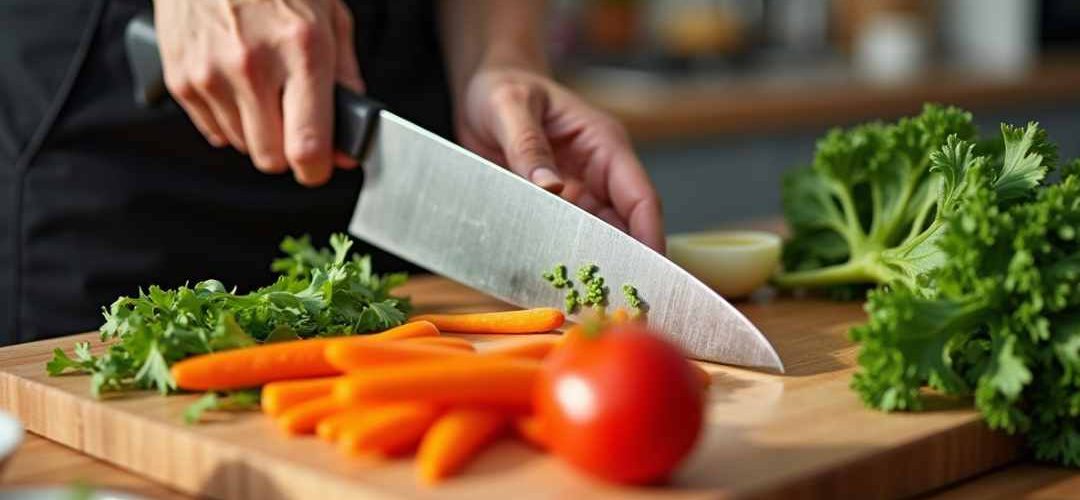
A sharp knife and the knowledge to use it properly will transform your cooking more than any gadget or appliance. These ten techniques, once practiced and internalised, will make prep work faster, safer, and genuinely enjoyable.
1. The Pinch Grip
Hold the blade between your thumb and index finger just above the bolster, with your remaining fingers wrapped around the handle. This gives you maximum control and reduces fatigue during long prep sessions. Almost every professional chef uses this grip — and once you try it, you will wonder how you ever cooked without it.
2. The Claw
Curl your fingers inward so your knuckles guide the blade and your fingertips are tucked safely away. Your knuckles act as a fence, keeping the knife at a consistent distance from your fingers. Practice this slowly until it becomes automatic.
3. The Rock Chop
Keep the tip of the knife on the board and rock the heel up and down through herbs, garlic, and onions. This is the most efficient motion for fine chopping and produces beautifully even results.
4. Julienne Cuts
Slice vegetables into thin planks, stack them, then cut into matchsticks. Aim for 3mm thickness for classic julienne. This technique is essential for stir fries, salads, and garnishes.
5. The Brunoise
Take your julienne strips and rotate them 90 degrees, then slice again into tiny cubes. This produces the finest dice possible and is the foundation of classical French cooking.
A dull knife is more dangerous than a sharp one — it requires more force and is more likely to slip.
6. Chiffonade
Stack leafy herbs or greens, roll them tightly into a cylinder, and slice across to create fine ribbons. Perfect for basil, mint, and large-leafed greens.
7. Breaking Down a Whole Chicken
Learning to joint a chicken yourself saves significant money and gives you carcasses for stock. Remove the legs first, then the wings, then run your knife along both sides of the backbone to release the breasts.
8. Fish Filleting
Use a flexible boning knife and let the blade follow the spine of the fish, using long, confident strokes. The key is not to saw — one clean draw of the blade per stroke.
9. Honing Your Knife
Honing realigns the edge of your blade and should be done before every use. Hold the steel vertically and draw the blade down at a 15-20 degree angle. Ten strokes per side is usually sufficient.
10. When to Sharpen
Sharpening removes metal to create a new edge, and should be done when honing is no longer effective — typically every 2-3 months for a home cook. A sharp knife glides through a ripe tomato without any pressure.
